
A sales channel is an allocation label on inventory you already have. It primarily answers which buyers are allowed to select this seat before it sells? and can optionally carry a sparse price book for that audience.
Everything else stays exactly where it was. One event, one chart, one authoritative seat count.
This is the canonical feature overview for channels, allocation, organizer controls, and Partner access. Continue according to your role:
| Your job | Read next |
|---|---|
| Configure an allocation and connect an authenticated private selling flow | Organizer guide: integrate private sales |
| Operate inventory an organizer assigned to your organisation | Partner guide: sell an allocation |
| Implement exact allocation and lifecycle operations | Sales Channels API |
| Mint short-lived browser authority for private inventory | Buyer Access Sessions API |
The one-minute model
Take a 1,000-seat event:
| Allocation | Seats | Who may select them |
|---|---|---|
| Public sale | 800 | Anyone on a Managed public page or a public-key Platform embed |
| Travel Agency A | 120 | Buyers carrying an Agency A buyer access session |
| Sponsor guests | 50 | Sponsor invitees |
| Box office | 30 | Your own staff selling flow |
All four audiences read the same event, the same chart geometry, and the same
inventory. Selling A-12 through Travel Agency A makes A-12 booked
everywhere, immediately: on the public page, in your reports, and in every
open buyer session. There is no reconciliation step or second source of
truth, because there is no second inventory.
SeatLayerOne Event and one chart
Every channel starts from the same seat map and the same physical seats.
AudienceEach buyer sees their allocation
Public sale, a travel agency, sponsor guests, and box office staff can each receive different access.
SeatLayerOne authoritative inventory
A hold or booking through any channel changes availability everywhere immediately.
Assignment is not status
A seat’s channel and a seat’s status are independent. Every seat always has both.
| Status | free, held, booked, blocked: what is physically true |
| Channel | Public sale, or exactly one private channel: who may select it |
Assigning a seat to a channel never changes its status. A free seat in a private channel is still free; it is simply invisible to buyers who are not eligible for that channel. This is why assignment is safe to run on a live, selling event.
It is also why a channel is not a way to take a seat off sale. If nobody should sell it, block it.
What a channel is not
The five things that get confused with channels, and the feature that actually does each job:
| What you want | Use |
|---|---|
| Nobody may sell this seat | Block |
| Reserve it during checkout | Hold |
| Open or close a section for everyone | Section availability |
| Change the event’s base price or visual treatment | Category and pricing |
| Give one allocated audience a different price | Sales channel pricing |
| Let only a particular audience select it | Sales channel |
One seat, one channel
A seat belongs to Public sale or to exactly one private channel. Never two.
Overlapping membership makes “how many seats does the sponsor have?” unanswerable and turns every allocation edit into a precedence question. A buyer may see several allocations, but a seat belongs to only one. A buyer access session can name several channels at once, so a sponsor who is also an agency customer sees both allocations without either seat being in two places.
That keeps every allocation total exact and every seat’s answer to “whose is this?” a single value.
Public sale is a real allocation, not an absence
Seats not assigned to a private channel are Public sale. It behaves like any other allocation in reports and in the API, with counts, sell-through, and inventory movements. Two differences apply:
- it is the default, so every event you already have is entirely Public sale and stays that way until you say otherwise. There is no migration;
- a Managed public/unlisted event needs no grant for Public sale, while a
Platform/SDK embed uses its publishable
publicKeyto obtain an origin-bound, Public-only session directly from SeatLayer.
In the API, Public sale is the reserved channel id public, and a seat on
public sale reports channelId: null. The direct public-key bootstrap fixes its
scope to Public sale and accepts no browser-supplied channel list. A server-requested
buyer access session must still say
includePublic explicitly. There is no default, and it is required whenever the
buyer also needs private channel inventory.
Manage a channel in Control Room
Open the event, choose Channels, and use the channel rail as one continuous workflow: allocate inventory, choose how it is distributed, then preview what that audience can see.
Assign inventory at the right scale
Choose the destination channel first, then select inventory in the way that matches the job:
- Sections adds one or more complete sections;
- Rows adds several logical rows, including segmented rows shown as one row;
- Drag box selects a region directly on the map;
- Category adds every seat in a price or access category;
- Seat list provides the same selection with keyboard-accessible checkboxes;
- clicking individual seats remains available for small corrections.
Selections are additive and stay staged until you review and apply them. The review separates seats added from Public sale, seats moved from another private channel, seats already at the destination, and seats that cannot move because they are held or booked. Moving inventory out of another private channel is the only ordinary assignment that needs an extra confirmation.
Category, section, and row selection expand to the exact inventory units that exist when the assignment is applied. They are not permanent allocation rules: after publishing new seats or changing labels, review the Channel again because new inventory starts on Public sale until it is deliberately assigned.
After Apply, the review closes and a success bar reports exactly how many seats moved and how many were skipped. Details keeps the authoritative server breakdown available without making it a second required step.
Choose a distribution method
Open a private channel and choose Distribute this channel. Only the setup for the selected method is shown:
| Method | Use it when |
|---|---|
| Keep as protected reserve | Nobody should have buyer access yet. The inventory remains outside Public sale. |
| Sell through your own staff | Box office or internal staff fulfil the allocation. |
| Sell with a buyer link | You want to send a hosted capability link to guests, sponsors, or a known group. |
| Integrate a website or app | For this private channel, your backend authenticates each eligible buyer and creates a short-lived, scoped buyer session. Ordinary Public sale uses publicKey directly and does not call this endpoint. |
Changing the distribution method does not move seats. A self-service method is marked Set up until an active link or buyer session exists, and Live only when the server confirms buyer access is active.
Set a channel price only where it differs
Open a private channel and choose Edit prices. Each blank field inherits the event’s current category or ticket-tier price; enter only the audience prices that differ. Saving is versioned, so if another operator changed this price book while you were editing, Control Room refreshes the current values and asks you to review instead of overwriting them.
Channel pricing is authoritative, not a display hint. The buyer sees the scoped price, the server resolves it again when the hold is created, and that hold freezes both the unit price and channel pricing version. A later edit changes future selections only. Public inventory and private inventory without an override continue to use event pricing.
If an active event ticket release overlaps a channel price, the narrower channel price wins and does not consume the release quota. At the Box Office, staff can deliberately select a named release; that explicit choice wins over the channel price and retains the release attribution.
Give a partner its own context: Partner access
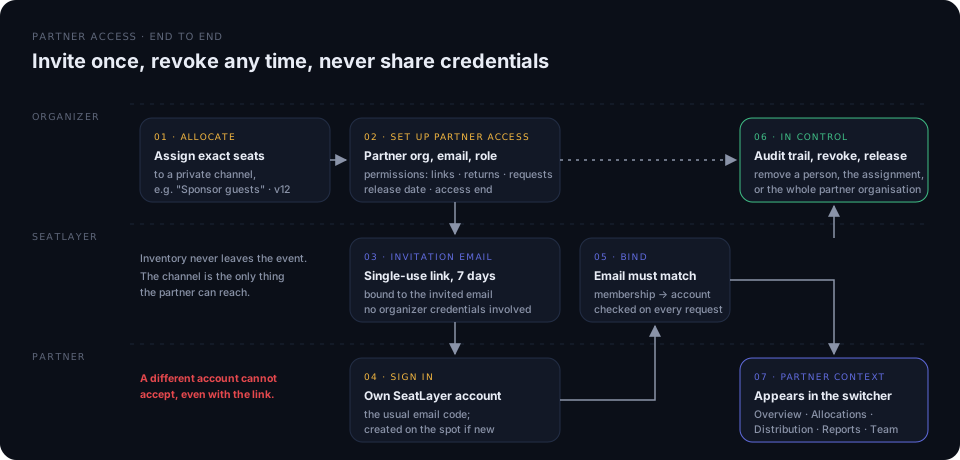
When an agency, sponsor, school, corporate group, promoter partner, or reseller needs to work its allocation rather than only read a report, open the private channel and choose Partner access. Name the partner organisation, invite one person by email, pick a role, and choose the permissions that channel carries.
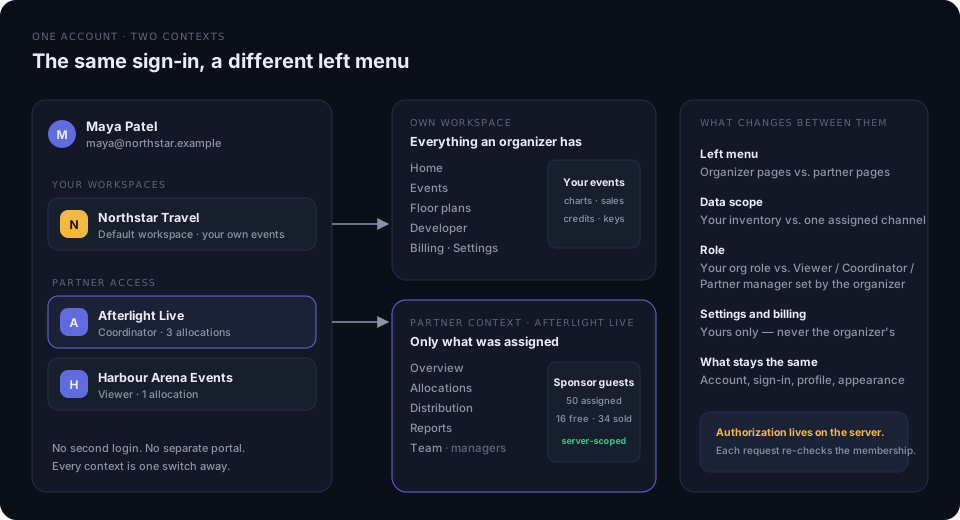
The partner does not get a login to your workspace and there is no separate portal. They accept with their own SeatLayer account (the invitation only works for the invited email; a new account is created on the spot if needed), and the access appears in their workspace switcher next to their own workspaces. Their own events, floor plans, and billing stay in their workspace; your channel lives in a partner context with its own left menu: Overview, Allocations, Distribution, Reports, and Team.
Roles
| Role | Can |
|---|---|
| Viewer | See the assigned allocation, exact seats, attributed sales, and export the CSV. |
| Coordinator | Viewer, plus the write actions you enable: create and revoke buyer links, return free seats, request more inventory. |
| Partner manager | Coordinator, plus invite and remove people in the partner organisation and change their roles. |
Roles are set per person. You can change a role or remove a person at any time, and a Partner manager can do the same for their own teammates from the Team page (never for themself). A change takes effect on the partner’s next request.
Permissions and terms on the assignment
| Setting | Effect |
|---|---|
| Create buyer links | Hosted buyer links inside your limits (expiry, redemptions, seats per buyer, session length). Only offered on events sold through SeatLayer checkout. |
| Show Public sale in links | Off by default; when on, the partner may let its buyers also pick from public inventory. |
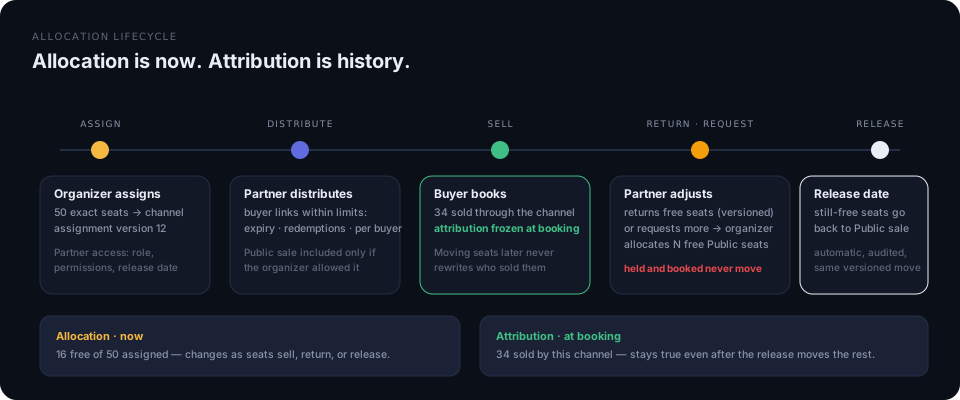
| Return free inventory | Free seats only, against the assignment version the partner reviewed; held, booked, and blocked seats never move. |
| Request more inventory | One open request at a time. You allocate N free Public-sale seats directly from the request, mark it handled, or decline. |
| Release date | At that moment, whatever is still free in the channel returns to Public sale automatically, audited, through the same versioned move. |
| Access ends | The context disappears for every member after this date. |
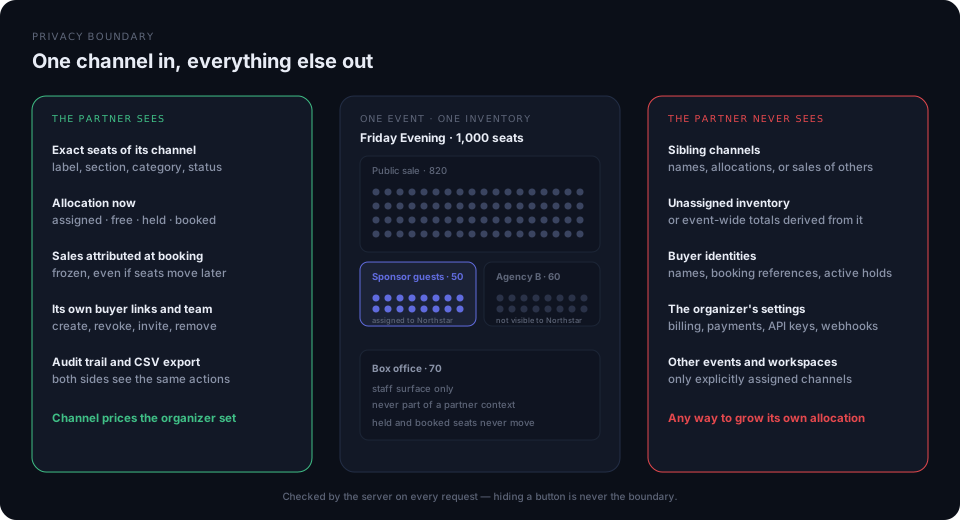
Every partner request is authorised on the server against the membership, assignment, role, and enabled permission. Hiding a button is not an authorisation boundary. A partner cannot expand its own allocation, see a sibling channel, buyer identities, booking references, or anything in your settings and billing.
Revoking
- Remove a person: that account loses the partner context for every allocation you have given that partner organisation.
- Remove the assignment: the channel leaves every member’s context; the inventory does not move.
- Remove the partner organisation: ends every assignment of that partner in your workspace.
Existing buyer holds keep their ordinary lifecycle. Buyer links the partner created stay live until you revoke them from the channel’s access links, so buyers who already received a link are not cut off by surprise.
Preview before distribution
Use Preview buyer access to request the same server projection a buyer session receives. This checks the real channel scope and optional Public sale access; it is not a browser-side approximation and cannot create holds.
Share a live report with the channel partner
From Performance → Channel, choose Share partner report on a private channel. The partner opens a clean, read-only report with:
- the selected channel’s allocation, sell-through, and attributed sales;
- the exact assigned seat or inventory labels and their current status;
- search and status filters for large allocations; and
- a CSV export of that same scoped inventory.
Other channel names, buyer identity, booking references, and event-wide totals are never included. Attributed revenue is off by default and must be enabled for each link. Creating and revoking links remains an organizer action; the partner does not need a SeatLayer account.
The URL is shown once, can expire after 7–180 days, records its view count and last-viewed time, and can be revoked immediately. It is a bearer capability, so forwarding it gives the recipient the same read-only access.
For a recurring partner that needs organizer-approved distribution, return, or request actions, use Partner access instead. It keeps the same event/channel privacy boundary while binding access to the partner’s own verified SeatLayer account rather than a shared report URL.
A channel id is not authorization
A channel id is a label, not a key. Sending one from a browser grants nothing, and a browser cannot select private inventory by naming a channel it guessed, was told, or read out of your page source. The server derives what a caller may select from the credential the caller presents, and ignores any channel the client claims.
What actually grants access:
- a buyer access session (
bse_…), requested by your backend and minted by SeatLayer for one buyer, one event, one origin, and a named set of channels; - a hosted access link, which a buyer exchanges for one of those sessions;
- a Partner access membership, checked on every request against the partner’s own verified account, the assignment, the role, and the permission set;
- a secret key that explicitly names the channel it is acting for. See the booking behavior change.
An unauthorized buyer does not receive a private seat’s real state at all. Private inventory reads as one flat unavailable state, whatever is really happening inside it, and a public map receives no updates from activity it is not allowed to observe.
Continue by role
- Partner guide: sell an allocation: hosted-link selling and the organizer-brokered SDK path
- Sales Channels API: create, price, assign, pause, and archive
- Buyer Access Sessions API: mint and revoke buyer scope
- Organizer guide: integrate private sales: the end-to-end implementation
- Reports: allocation and sale attribution per channel